What Happened
Business teams are creating more operational data than their existing review habits can absorb, and field service territory balancing is a clear example. The work is not failing because people do not care. It is failing because territories drift as demand, skills, traffic, customer density, and emergency work patterns change. The process usually depends on scattered email threads, spreadsheet notes, system exports, and individual memory. That can function when volume is low, but it becomes fragile once customer expectations, compliance needs, and daily transaction speed increase.
The common response is to add reminders, meetings, or a shared tracker. Those tools help for a short period, but they do not change the operating model. A reminder still leaves someone to interpret context manually. A spreadsheet still goes stale if ownership is unclear. A meeting still spends time discovering facts that could have been assembled before anyone joined the call. For field service territory balancing, the missing ingredient is a live review queue that continuously converts signals into work.
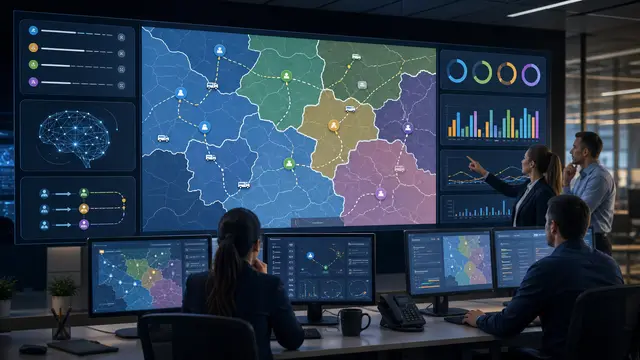
AI and automation can create that queue without pretending that the system should make every final decision. The automation watches for signals such as work order history, drive time, technician skills, first-time fix rate, appointment windows, customer priority, parts availability, backlog, and home base location. AI summarizes the situation, explains why the item needs attention, suggests the likely lane, and prepares the context a human reviewer needs. The result is a practical decision desk for dispatch, field service managers, technicians, customer support, and operations leadership.
This is a better model than occasional cleanup because it fits how businesses actually operate. Work arrives every day. Risk changes every day. Customers and employees expect fast answers. A queue gives the organization a rhythm for reviewing exceptions before they become expensive. It also gives leaders a way to see whether the process is improving or merely surviving through individual effort.
A useful example is this: a cluster of work orders that repeatedly pulls technicians across a boundary can trigger a proposed account reassignment or shared specialist coverage plan. In a manual process, that pattern may be noticed only after a complaint, audit request, missed deadline, or escalated customer issue. In an AI-assisted process, the pattern becomes visible early enough for the right owner to act. That shift from reaction to readiness is where automation creates business value.
Why It Matters for Businesses
The business case for automating field service territory balancing starts with time, but it does not end there. Manual review consumes attention from skilled people who should be solving exceptions, not hunting for basic facts. When the evidence is scattered, teams spend too much time asking what happened, who owns it, whether the information is current, and what rule applies. AI can prepare that context so reviewers spend more of their time making accountable decisions.
The second issue is risk. When field service territory balancing is handled informally, the organization often cannot prove why a decision was made. That is uncomfortable during audits, customer disputes, management reviews, security questions, and process improvement discussions. The risk is not only that something goes wrong. The risk is that the company cannot reconstruct the path from signal to decision. A structured workflow creates the evidence trail as a byproduct of normal work.
The third issue is consistency. Two employees may handle the same situation differently because they have different experience, different inbox context, or different interpretations of policy. That does not mean either employee is careless. It means the process is carrying too much in personal judgment. AI-assisted workflows can present the same categories, rules, and supporting evidence to every reviewer while still allowing human judgment for exceptions.
For leaders, the advantage is visibility. Instead of asking for anecdotal updates, managers can review queue volume, aging, escalation reasons, completion rates, and outcome patterns. In this workflow, the most relevant measurements include average drive time, jobs completed per day, overtime, missed windows, repeat visits, response time, backlog by region, and utilization by skill. Those numbers make improvement concrete. They also show where policy, training, source data, or system integration needs attention.
The customer impact is equally important. Customers do not see the internal handoffs behind a process. They see whether the company answers accurately, invoices correctly, schedules reliably, protects information, or delivers on a commitment. When field service territory balancing is weak, the customer experience feels inconsistent. When the workflow is managed, the customer experiences fewer surprises and faster resolution.
There is also an employee experience benefit. People are more willing to follow a process that gives them a clear queue, a reason for each item, and a specific next action. They are less willing to support a process that sends vague alerts or expects them to search through multiple systems. Good automation reduces cognitive load. It gives employees a short list of meaningful decisions rather than a long list of unstructured chores.
The Practical Automation Opportunity
A practical automation should start narrowly. The best pilot for this topic is one region with growing overtime, high emergency volume, or repeated cross-boundary dispatches. Starting there gives the team enough volume to learn from real cases without trying to redesign the entire company at once. The pilot should define which records or transactions enter the queue, who can review them, what decisions are allowed, and what evidence must be captured.
The intake layer should be simple and reliable. Pull data from the systems that already hold the strongest signals. That might mean a scheduled export, an API connection, a watched folder, a CRM report, a billing report, a dispatch report, or a support ticket view. The first version does not need every possible field. It needs enough context to identify items that deserve review and route them correctly.
AI should be used for interpretation and preparation. It can summarize the item, classify likely category, compare it with a rule or playbook, identify missing information, and suggest a recommended lane. For this workflow, useful lanes include boundary review, shared specialist pool, remote-area scheduling rule, parts staging change, emergency reserve capacity, or customer communication needed. The recommendation should include a short explanation so the reviewer understands why the item is in the queue.
Human approval should remain explicit where consequences matter. The workflow should not hide important decisions behind automation. Reviewers should be able to approve, reject, reassign, request more information, or override the suggestion. Every override is useful data. It shows where policy is unclear, where AI classification needs tuning, or where source data is incomplete.
Governance needs to be designed into the workflow from the beginning. At minimum, the process should capture manager approval, dispatcher feedback, technician constraints, customer impact, expected metric change, and post-change review. That record does not need to be complicated, but it does need to be consistent. If the business later needs to explain a decision, the evidence should already exist.
The first operating dashboard should be plain. Show new items, overdue items, items by lane, escalations by owner, average time to close, and outcome trends. Avoid making the dashboard too clever. The purpose is to help managers see whether work is flowing and whether risk is shrinking. If a lane grows every week, the workflow is exposing a real bottleneck that needs a process decision.
Rollout should include training that focuses on decisions, not software features. Reviewers need to know what each queue lane means, when to trust a recommendation, when to override it, and how to document a reason. Managers need to know how to read the metrics. Executives need to know which outcomes justify expansion. This keeps the automation connected to business accountability.
A 30-day pilot can be enough to prove direction. In week one, define categories and connect the source data. In week two, run the queue in observation mode and compare AI suggestions with human judgment. In week three, let reviewers work from the queue with clear approval rules. In week four, review metrics, false positives, missed cases, and employee feedback. Then decide whether to expand, tune, or pause.
The financial model should be realistic. Do not claim value only from headcount reduction. Better measures include avoided rework, faster cycle time, fewer escalations, less aging risk, improved customer response, reduced manual research, and clearer compliance evidence. For many businesses, the strongest ROI comes from preventing problems that are expensive to unwind after the fact.
Integration can deepen over time. Once the team trusts the workflow, automation can create tasks in the system of record, send customer or internal requests for missing information, update status fields, schedule follow-up reviews, and notify managers when risk thresholds are crossed. These actions should come after the decision logic is trusted, not before. The right sequence is visibility, review, confidence, then deeper automation.
Business Takeaway
AI is most useful in field service territory balancing when it turns scattered signals into accountable work. It does not need to replace expert judgment to create value. It needs to find the items that deserve attention, prepare the context, suggest a lane, and record what happened next. That is the foundation of practical business automation.
The next step is to pick the workflow slice where productive hours disappear into travel, overtime rises, appointment windows slip, technician frustration grows, and customer service levels become inconsistent are already visible. Build a review queue around that slice, measure the first month carefully, and improve from real decisions. When the company can see the work, assign it, and learn from it, automation becomes more than a technology project. It becomes a disciplined way to protect margin, time, trust, and operational control.