What Happened
Most companies say they want to learn from won and lost deals, but the review process is often sporadic. A manager asks for notes after a big loss. A salesperson updates a close reason in the CRM with a generic label. Marketing gets a handful of anecdotes. Product hears about missing features through hallway conversation. Then the business moves on to the next quarter with the same patterns hidden inside call recordings, emails, proposal revisions, discount requests, and customer objections.
An AI win loss review loop changes that rhythm. It creates a repeatable way to collect deal evidence, summarize buying signals, categorize objections, compare promised value with actual buyer priorities, and convert lessons into sales execution improvements. The goal is not to score salespeople after the fact. The goal is to make the organization better at recognizing what buyers care about, where deals stall, and which internal behaviors help or hurt momentum.
The raw material already exists. CRM stage history shows where the opportunity slowed. Call summaries reveal recurring concerns. Proposal versions show which terms changed. Email threads show unanswered questions. Discount requests reveal pressure points. Implementation notes may reveal whether sold expectations were realistic. AI can bring those signals together and produce a useful deal narrative faster than a manager can manually reconstruct the story.
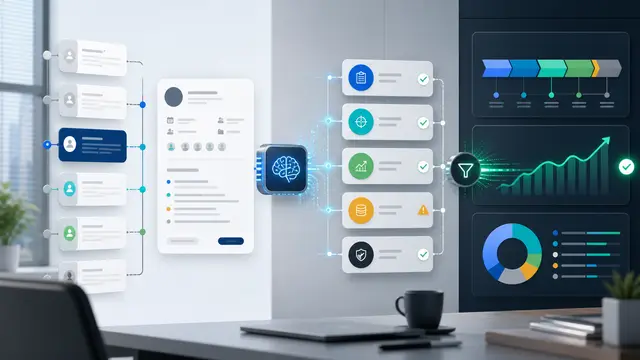
A strong workflow begins at deal close. When an opportunity is marked won or lost, automation gathers the relevant records and asks AI to create a structured review. The review should include customer context, buying committee signals, primary business pain, decision timeline, competitors mentioned, objections raised, pricing pressure, content used, internal delays, and the final stated reason. It should separate evidence from interpretation so the team can see what is known and what is inferred.
The loop becomes valuable when the review leads to action. A lost deal due to unclear implementation timeline should inform sales enablement and operations. A won deal that moved quickly after a specific ROI discussion should become a coaching example. Repeated objections around integration should reach product marketing or solution engineering. Patterns, not isolated stories, should guide the next improvement.
Why It Matters for Businesses
Win loss learning matters because sales execution is expensive to improve through guesswork. Teams often invest in new scripts, tools, campaigns, or training without clear evidence of the friction they are trying to remove. AI-assisted review provides a more grounded view. It shows whether deals are lost because of price, trust, timing, missing proof, weak discovery, poor handoffs, feature gaps, slow approvals, or a mismatch between buyer need and seller message.
This helps leaders avoid the trap of overreacting to the loudest anecdote. One dramatic loss can distort a quarter. A structured review loop can show whether that loss was unusual or part of a pattern. It can also reveal quiet strengths. Perhaps mid-market deals close faster when sellers include a technical owner early. Perhaps renewal expansion improves when customer success provides usage evidence before procurement gets involved. These insights are practical because they connect behavior to results.
The workflow also improves accountability across departments. Sales may believe product needs a feature. Product may believe sales is selling to the wrong buyer. Marketing may believe the field is not using available content. Operations may believe timelines are being promised too loosely. A review loop gives every team a shared evidence base. That makes the conversation more useful and less political.
The ROI can be tracked through several measures: better close rates in target segments, fewer late-stage losses for preventable reasons, faster onboarding alignment after closed-won deals, reduced discount leakage, improved forecast accuracy, and shorter coaching cycles for new reps. The immediate benefit is time saved in review preparation. The larger benefit is better decision quality.
For business owners and revenue leaders, the point is simple. Every deal teaches something. Without a system, the lesson expires quickly. With AI and automation, the lesson becomes part of the operating model.
The Practical Automation Opportunity
The practical automation opportunity is to build a closed loop around deal evidence.
- Trigger a review whenever a meaningful deal closes won, closes lost, or stalls beyond a defined threshold.
- Pull structured CRM fields, stage history, activities, meeting notes, email summaries, proposal versions, and approval history.
- Use AI to generate a deal narrative with evidence citations back to internal records when possible.
- Classify objections into operational categories such as price, timing, trust, proof, technical fit, implementation confidence, authority, and internal delay.
- Route insights to the right owner: sales manager, marketing, product, operations, customer success, or finance.
- Create tasks for specific follow-up, such as updating a talk track, adding a proof point, clarifying an implementation handoff, or reviewing discount policy.
- Report patterns monthly so leadership sees trends instead of isolated deal stories.
Start by reviewing a small set of recent deals manually with the intended output in mind. Identify which fields are reliable and which notes are too inconsistent. Then create a standard review format. AI performs best when the expected structure is clear. The review should make room for uncertainty, such as "evidence suggests" or "no clear buyer objection found," because false confidence is worse than an incomplete answer.
Human review is still important. Sales managers should approve or adjust summaries before they become coaching material. Product and marketing should see aggregated patterns rather than raw personal judgments about individual reps. Sensitive customer comments should be handled with care. The workflow should improve learning, not create a surveillance culture.
A mature loop connects to enablement. If AI identifies a recurring objection, the system can check whether there is current content that addresses it. If not, it can open a content request with examples. If a competitor appears repeatedly, it can alert the product marketing owner. If implementation uncertainty slows deals, it can trigger a standard operations explanation or timeline worksheet. That is where the loop starts creating operational leverage.
The system should also track whether actions worked. If a new discovery guide is launched, do related objections decline? If a pricing approval checklist is revised, do late-stage discount delays shrink? Automation should not only surface insights. It should help the organization test whether the response improved execution.
Business Takeaway
A win loss review loop turns sales learning from occasional storytelling into a repeatable management system. AI makes the evidence easier to gather, compare, and summarize, while automation makes sure the lessons reach the people who can act on them. The best version is fair, structured, and focused on better execution. It helps businesses sell with more precision because every closed deal contributes to the next better conversation.
A useful next step is to document the manual decision exactly as it happens today, including the trigger, the data checked, the person who approves the action, the message sent, and the metric reviewed afterward. That map prevents automation from becoming a vague technology project. It makes the workflow concrete enough to pilot, measure, and improve without disrupting the rest of the business.
A useful next step is to document the manual decision exactly as it happens today, including the trigger, the data checked, the person who approves the action, the message sent, and the metric reviewed afterward. That map prevents automation from becoming a vague technology project. It makes the workflow concrete enough to pilot, measure, and improve without disrupting the rest of the business.
A useful next step is to document the manual decision exactly as it happens today, including the trigger, the data checked, the person who approves the action, the message sent, and the metric reviewed afterward. That map prevents automation from becoming a vague technology project. It makes the workflow concrete enough to pilot, measure, and improve without disrupting the rest of the business.
A useful next step is to document the manual decision exactly as it happens today, including the trigger, the data checked, the person who approves the action, the message sent, and the metric reviewed afterward. That map prevents automation from becoming a vague technology project. It makes the workflow concrete enough to pilot, measure, and improve without disrupting the rest of the business.
A useful next step is to document the manual decision exactly as it happens today, including the trigger, the data checked, the person who approves the action, the message sent, and the metric reviewed afterward. That map prevents automation from becoming a vague technology project. It makes the workflow concrete enough to pilot, measure, and improve without disrupting the rest of the business.
A useful next step is to document the manual decision exactly as it happens today, including the trigger, the data checked, the person who approves the action, the message sent, and the metric reviewed afterward. That map prevents automation from becoming a vague technology project. It makes the workflow concrete enough to pilot, measure, and improve without disrupting the rest of the business.
A useful next step is to document the manual decision exactly as it happens today, including the trigger, the data checked, the person who approves the action, the message sent, and the metric reviewed afterward. That map prevents automation from becoming a vague technology project. It makes the workflow concrete enough to pilot, measure, and improve without disrupting the rest of the business.