What Happened
Customer onboarding has become one of the most important operating moments in a business relationship. A sale may close in the CRM, a contract may be signed, and the kickoff call may be scheduled, but the customer is still forming an opinion about whether the company can deliver. The first few weeks expose every handoff weakness. Missing implementation notes, unclear success criteria, delayed access, late training, and unassigned technical questions can quietly drain momentum before anyone labels the account at risk.
Many teams still manage onboarding health through manual check-ins. A project manager reads notes, a customer success manager asks for updates, operations reviews a spreadsheet, and leadership hears about problems only when a milestone is already late. This works when volume is low and every customer receives intense attention. It starts to break when more deals close, implementation paths vary, and teams use several systems to coordinate work. The signals exist, but they are scattered across CRM records, ticketing queues, meeting notes, project tasks, billing setup, product usage, and email threads.
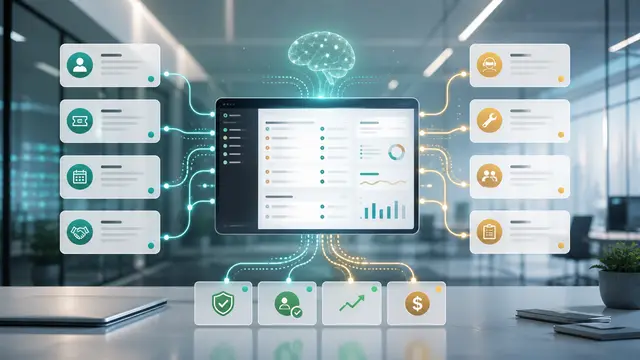
AI changes the practical shape of onboarding oversight by making those scattered signals easier to interpret. It can summarize open blockers, compare actual progress against the expected implementation path, detect weak or vague notes, identify unanswered customer questions, and flag accounts where the pattern of activity does not match the promised outcome. The value is not that AI replaces the onboarding team. The value is that AI gives the team an earlier, clearer health check while there is still time to act.
A strong onboarding health check does not need to be complicated. It starts with a small set of business questions. Has the customer completed the setup steps that matter for value? Are internal owners assigned to each blocker? Has the customer attended the sessions needed to move forward? Are technical access items resolved? Are notes specific enough for another team member to understand the current state? Are upcoming milestones realistic based on the work still open? Each question can become a monitored signal.
The most useful AI onboarding workflows focus on patterns instead of isolated events. A single late task may not be a problem. A late task combined with missed meetings, unanswered implementation questions, and a vague handoff note is a different story. AI can group those signals into a health narrative that a manager can review quickly. Instead of asking, What is going on with this account, the manager sees the likely issue, the evidence behind it, and the next action that needs an owner.
This approach is especially valuable for businesses that sell services, subscriptions, implementation packages, managed websites, software, consulting, or recurring support. In those models, the customer experience after the sale often determines retention and expansion. A smooth onboarding process protects trust. A confusing one creates avoidable service pressure later. AI helps teams notice where the relationship is becoming harder than it should be.
Why It Matters for Businesses
Onboarding problems are expensive because they compound. A small delay in access can push back training. Late training can delay adoption. Delayed adoption can make the customer question the value of the purchase. A vague note can cause the support team to ask the customer for information they already provided. None of these moments may appear large on their own, but together they create friction that damages confidence.
The business case for AI onboarding health checks is not built on novelty. It is built on preventing avoidable rework and preserving customer momentum. When teams identify risk earlier, they can assign help before the customer escalates. They can adjust timelines before commitments become unrealistic. They can bring sales context into delivery before expectations drift. They can make sure the customer hears a coherent story from every department.
The measurable gains often appear in several places:
- Fewer stalled implementations because blockers are surfaced before status meetings.
- Shorter time to first value because required tasks are not waiting unnoticed.
- Better handoffs from sales to delivery because missing context is flagged quickly.
- Lower support burden because customers receive clearer setup guidance earlier.
- Stronger retention because the customer feels progress instead of confusion.
- More accurate management reporting because health status is based on evidence, not memory.
AI also helps leaders see whether onboarding problems are systemic. If the same setup step repeatedly creates delays, the issue may be documentation, product design, training, pricing expectations, or staffing. Without structured signal review, the business treats each problem as a one-off account issue. With an AI-assisted workflow, recurring friction becomes visible. That gives leadership a better basis for improving the process itself.
The governance angle matters too. Customer-facing automation can become risky when it sends messages without context or hides uncertainty. A good onboarding health check keeps AI in an advisory role. It summarizes, scores, groups, and recommends, but humans still decide how to respond. The workflow should show why an account was flagged, which source systems contributed to the signal, and what action was taken. That creates accountability without slowing the team down.
For small and midsize businesses, the opportunity is often immediate because the data already exists. The company does not need a massive transformation program. It needs a disciplined way to connect CRM, project management, support, and meeting notes into a repeatable review. Even a weekly AI-generated onboarding risk list can be enough to change behavior. Managers stop relying on who speaks up the loudest and start reviewing accounts based on consistent signals.
The Practical Automation Opportunity
A practical AI onboarding health workflow starts with the onboarding journey map. Define the core stages customers move through, such as kickoff completed, access provisioned, discovery confirmed, configuration started, training delivered, first use achieved, and success handoff completed. Each stage should have a clear signal that can be checked. If a stage depends on a human note, define what a useful note must include.
Next, connect the systems that hold onboarding evidence. This may include CRM opportunity details, customer success records, project tasks, support tickets, shared documents, billing status, training attendance, and product usage. The goal is not to centralize every field. The goal is to give the AI enough context to answer the operating questions that matter. Start with read-only connections where possible so the first version produces insight without changing systems automatically.
Then create a health-check routine. On a set schedule, AI reviews active onboarding accounts and produces a compact record for each one. The record should include the current stage, expected next milestone, open blockers, weak or missing notes, customer-facing risks, internal owner gaps, and a recommended next action. A simple red, yellow, green score can be useful, but it should never stand alone. The explanation is where the business value lives.
A strong workflow includes quality controls:
- Require every risk flag to cite the source signal, such as a task date, ticket status, missing owner, or note summary.
- Separate confirmed issues from possible issues so teams do not overreact to weak evidence.
- Give account owners a way to accept, dismiss, or correct a recommendation.
- Track actions taken after a flag so the system can show whether intervention improved outcomes.
- Review false positives regularly and adjust the criteria.
- Keep customer messaging human-reviewed until the process is mature.
The automation can also generate role-specific views. A customer success manager needs a prioritized list of accounts needing attention. An implementation lead needs blocker categories and owner gaps. A sales leader needs expectation drift and promises that may require clarification. An executive needs trends by segment, product, region, and onboarding package. AI can turn the same source signals into different summaries without forcing every stakeholder into the same dashboard.
The best first pilot is usually narrow. Choose one onboarding path, one customer segment, and five to ten risk indicators. Run the health check for a month. Compare AI flags with manager judgment and customer outcomes. Measure time to first value, milestone slippage, number of escalations, and follow-up completion. Use those results to refine the workflow before expanding it.
A mature version can trigger downstream automation. For example, if access is not provisioned after a kickoff, the system can create an internal task. If a customer misses two required sessions, it can draft a human-reviewed outreach note. If a milestone is at risk, it can prepare a briefing for the account owner. If notes are too vague, it can ask the owner to add missing details. These actions are modest, but together they keep onboarding moving.
Business Takeaway
AI onboarding health checks give businesses an earlier view of customer momentum. They turn scattered signals into practical guidance, help teams intervene before delays become frustration, and make the first stage of the relationship more consistent. The best approach is not a flashy customer-facing bot. It is a disciplined internal workflow that watches the right signals, explains the risk, assigns the next action, and learns from the outcome. Companies that build this capability protect revenue, reduce rework, and give customers a more confident start.