What Happened
Policy acknowledgment sounds simple until a business needs to prove it. A new handbook is released, security rules are updated, safety procedures change, or a customer contract requires evidence that certain employees accepted a policy. The company sends the notice, receives confirmations across different tools, and assumes the record is complete. Months later, an audit request arrives and the team discovers gaps. Some employees acknowledged an older version. Some confirmations live in email. Some contractors were missed. Some departments used a different form. A few records have names that no longer match the HR system.
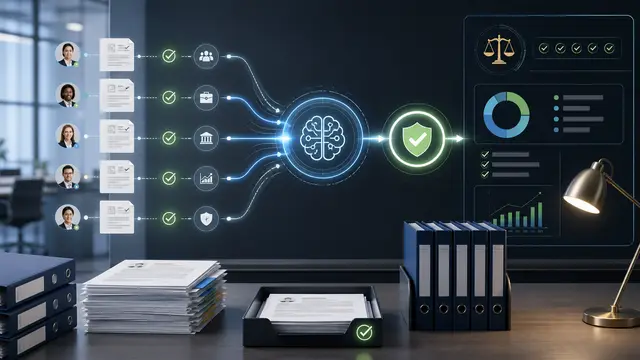
AI and automation can make policy acknowledgment reconciliation a continuous control instead of a last-minute evidence hunt. The workflow compares the policy population, version history, employee roster, training records, contractor lists, and acknowledgment logs. It identifies who is required to acknowledge which policy, who has completed it, who has the wrong version, and which records need follow-up or review. AI helps interpret messy records and summarize exceptions, while rules preserve the control logic.
This is especially useful for growing businesses. Small teams often rely on manual confirmation because everyone knows everyone. As the company adds locations, departments, contractors, or regulated customers, the process becomes fragile. The same policy may apply differently by role, geography, client assignment, or system access. A spreadsheet can work for a moment, but it does not provide reliable evidence when the business needs to answer quickly.
A practical workflow begins with policy inventory. Each policy should have an owner, effective date, version, applicable population, acknowledgment requirement, renewal cadence, and evidence standard. Automation then checks the authoritative people source, such as HRIS, identity management, learning platform, or contractor roster, and compares it with acknowledgment records. Exceptions are routed before the audit request arrives.
AI is useful because acknowledgment data is rarely perfectly clean. It can match names, flag likely duplicates, classify email confirmations, summarize why a person is in scope, and prepare manager-friendly follow-up. It can also read policy change notes and suggest which employee groups may need renewed acknowledgment. That does not replace compliance ownership. It gives the owner a cleaner queue and better context.
Why It Matters for Businesses
Policy acknowledgment gaps create risk because they are easy to underestimate. A missing record may seem administrative, but it can affect customer compliance, insurance requirements, safety obligations, cybersecurity controls, employee relations, and regulatory readiness. The business may be following the policy in practice, but without evidence it may struggle to prove control.
The operational cost is also real. When an audit request arrives, managers, HR, IT, and compliance staff often stop normal work to chase documentation. They search inboxes, export reports, compare spreadsheets, and ask department leaders to confirm details from memory. This creates stress and produces uneven evidence. A continuous reconciliation process spreads the work across normal operations and keeps exceptions small.
Better acknowledgment control improves trust with customers and partners. Many B2B relationships now include security, privacy, safety, or conduct requirements. When a customer asks for evidence, a business that can respond quickly looks mature. That response can support renewals, procurement reviews, cyber insurance, and vendor assessments.
The ROI is practical. Track reduction in audit preparation hours, percentage of in-scope employees current on required policies, average age of open acknowledgment exceptions, number of version mismatches, time to produce evidence, and manager follow-up completion. These metrics are not abstract. They show whether the business can prove its controls without disrupting operations.
There is also a cultural benefit. Employees receive clearer communication when the process is organized. Managers know which acknowledgments matter and why. Policy owners see whether adoption is complete. The company avoids sending broad reminder emails that confuse people who already completed the requirement.
The Practical Automation Opportunity
The practical automation opportunity is to build a control loop around policy scope, evidence, and exception handling.
- Maintain a policy register with owner, version, effective date, required audience, renewal cadence, and evidence requirement.
- Connect authoritative people data from HR, identity, learning, contractor, or access systems.
- Compare acknowledgment records against required populations and policy versions on a scheduled basis.
- Use AI to normalize names, interpret unstructured confirmations, summarize exceptions, and draft manager follow-up.
- Create exception categories such as missing acknowledgment, wrong version, terminated employee still in population, new hire pending, contractor missing, and evidence unclear.
- Route exceptions to managers or policy owners with deadlines and status tracking.
- Store evidence in a consistent location with an audit trail of reminders, completions, exclusions, and approvals.
Start with one policy that matters and one population that can be defined clearly. Security awareness, acceptable use, safety procedures, or customer-specific confidentiality terms are common candidates. Do not automate every policy at once. First prove that the business can define scope, reconcile records, and close exceptions reliably.
The workflow should separate policy judgment from evidence handling. A human policy owner decides who is in scope and what evidence is acceptable. Automation checks whether the evidence exists. AI helps make messy records easier to review. This division is important because compliance processes fail when no one owns the rule behind the report.
Build dashboards for action, not decoration. A useful dashboard shows policies with open exceptions, departments with aging gaps, version mismatches, and upcoming renewal requirements. It should also show exclusions and the reason for each exclusion. That prevents the same exception from being rediscovered every week.
Finally, create a response packet format before anyone asks for it. The packet can include policy name, version, effective date, scope definition, completion summary, exception status, and evidence export location. When an audit request arrives, the team should be refining a packet, not building one from scratch.
Business Takeaway
Policy acknowledgment is only simple when evidence is current, complete, and easy to retrieve. AI and automation help businesses keep that evidence ready by reconciling scope, records, versions, and exceptions before pressure arrives. The best workflow is modest at first, governed by clear ownership, and focused on proof. It gives leaders confidence that when someone asks who acknowledged what and when, the answer is already available.
A useful next step is to document the manual decision exactly as it happens today, including the trigger, the data checked, the person who approves the action, the message sent, and the metric reviewed afterward. That map prevents automation from becoming a vague technology project. It makes the workflow concrete enough to pilot, measure, and improve without disrupting the rest of the business.
A useful next step is to document the manual decision exactly as it happens today, including the trigger, the data checked, the person who approves the action, the message sent, and the metric reviewed afterward. That map prevents automation from becoming a vague technology project. It makes the workflow concrete enough to pilot, measure, and improve without disrupting the rest of the business.
A useful next step is to document the manual decision exactly as it happens today, including the trigger, the data checked, the person who approves the action, the message sent, and the metric reviewed afterward. That map prevents automation from becoming a vague technology project. It makes the workflow concrete enough to pilot, measure, and improve without disrupting the rest of the business.
A useful next step is to document the manual decision exactly as it happens today, including the trigger, the data checked, the person who approves the action, the message sent, and the metric reviewed afterward. That map prevents automation from becoming a vague technology project. It makes the workflow concrete enough to pilot, measure, and improve without disrupting the rest of the business.
A useful next step is to document the manual decision exactly as it happens today, including the trigger, the data checked, the person who approves the action, the message sent, and the metric reviewed afterward. That map prevents automation from becoming a vague technology project. It makes the workflow concrete enough to pilot, measure, and improve without disrupting the rest of the business.
A useful next step is to document the manual decision exactly as it happens today, including the trigger, the data checked, the person who approves the action, the message sent, and the metric reviewed afterward. That map prevents automation from becoming a vague technology project. It makes the workflow concrete enough to pilot, measure, and improve without disrupting the rest of the business.
A useful next step is to document the manual decision exactly as it happens today, including the trigger, the data checked, the person who approves the action, the message sent, and the metric reviewed afterward. That map prevents automation from becoming a vague technology project. It makes the workflow concrete enough to pilot, measure, and improve without disrupting the rest of the business.
A useful next step is to document the manual decision exactly as it happens today, including the trigger, the data checked, the person who approves the action, the message sent, and the metric reviewed afterward. That map prevents automation from becoming a vague technology project. It makes the workflow concrete enough to pilot, measure, and improve without disrupting the rest of the business.